
















I have always been an active person, interested in life, people, news, but after reacting badly to my second Covid vaccine, I developed ophthalmic nerve shingles. It was to affect me for six months and leave me with asthma so severe, I had to learn how to breathe again with a pulmonary physio. My day-to-day existence ground to dust, I found myself interested in nothing. I was overweight, listless and broken, all vibrancy gone. But at the end of 2021 I allowed myself to believe that, maybe, there was light at the end of the tunnel. I had learned to control my air hunger – the sensation of breathlessness experienced by asthmatics – and now, perhaps, with some encouragement, I might be able to put myself on a path back to wellness. My physio told me to start an exercise programme. It was going to need to be full-on, she told me, and I was going to have to commit to it properly.
Last Christmas came and went, and I found myself in a barn in Cornwall with my wife: she was scrolling through her phone, I was staring at the wind blowing through a field of grass. “Look at this,” she said, holding her phone up. They were transformation pictures from an exercise programme called the Six Pack Revolution. They were mind-blowing. Sometimes, things land in your lap right when you need them and, without thinking further, I signed up for the January wave.
The Six Pack Revolution is a 75-day food and exercise programme that gradually increases your fitness. It was established by Scott Harrison, a former double-glazing businessman who one day decided to do something about his softening “Dad Bod”. You’re assigned a group on Facebook, then helped by coaches who will support you when you wobble. There are Zooms with Scott throughout. Fans include Rylan Clark and Sara Cox.
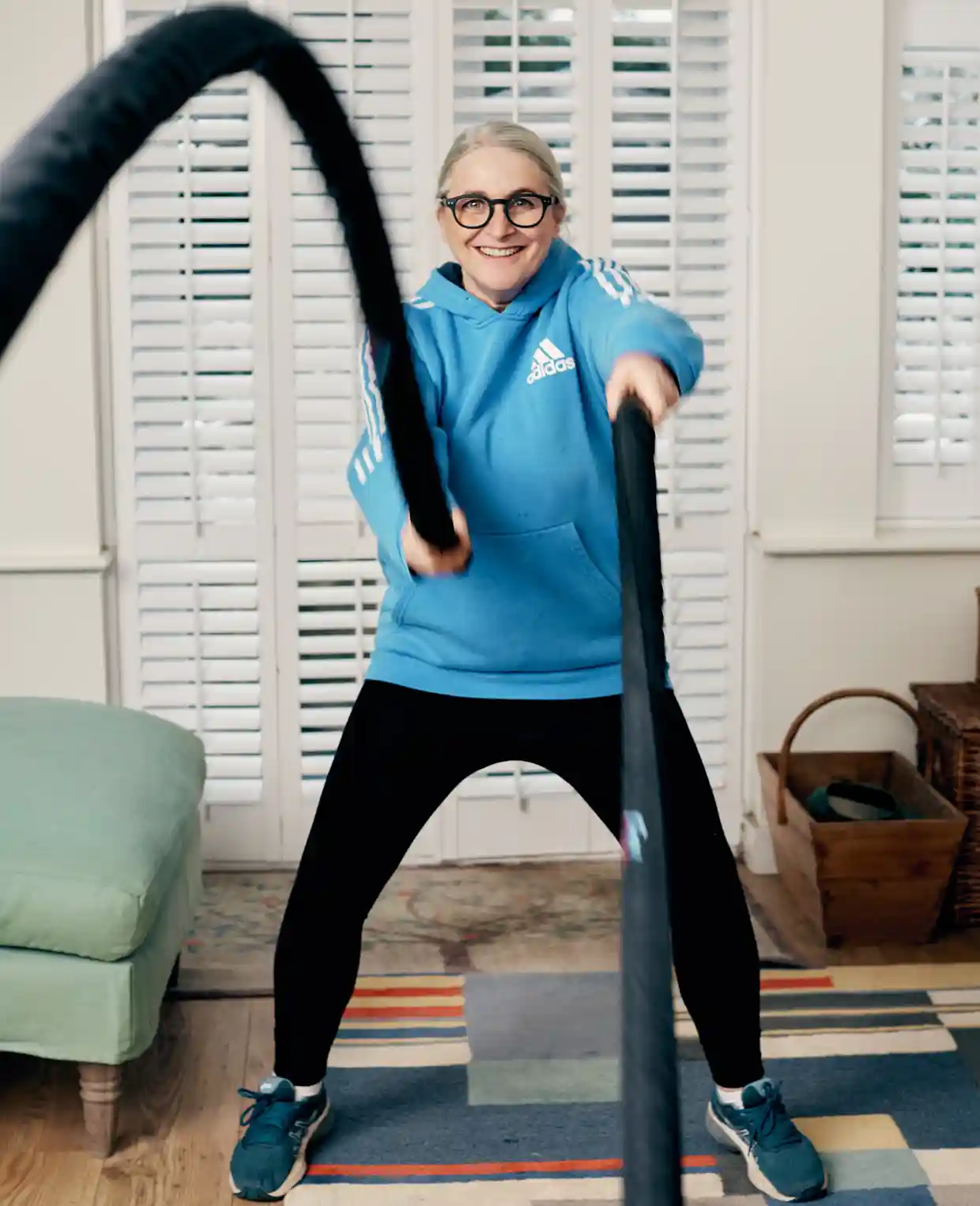
For me, starting at a point of absolute zero, it was perfect. First, you know there’s a finish line to cross; second, the exercise was going to step up in manageable gradients: in week one you’re asked to do 10 push-ups, 10 glute exercises and a range of ab exercises. In week two, that goes up to 20, and so on. These are called dailies and you have to do them six days a week. I chose the Signature programme (£139), but it has harder courses for people who have a good level of fitness. You will need a battle rope – buy one from Six Pack for £89.99 (or find them cheaper elsewhere – try mirafit.co.uk).
On day one, you can’t do 10 push-ups; by the end of the week you can. At the beginning of week two you can’t do 20 push-ups; by the end of the week you can. This pattern repeats for 11 weeks until, in your final seven days, you’re doing 110. These daily exercises aren’t remotely time-consuming – at the beginning you can have them done in 10 minutes (towards the end, allow 20). The key is sticking to it. For me, getting my dailies done before breakfast worked best. The great and motivating aspect of the programme is how you can see and feel immediate improvement. Exercises you struggle with on a Monday will feel easy by Sunday, and each week brings new exercises. It never gets stale.
In addition, you’re given physical challenges every Wednesday and Saturday, which you have to do only once but you can choose to do as many times as you like. The challenges are circuit-based high-intensity interval training (Hiit) and each lasts about 20 minutes. Most of the exercises are done with the battle rope: there’s a lot of squatting and using your own body for weight training. Turns out the only thing you need to tone up is you. Bargain. You can easily do everything in your own home: I conducted the programme in my sitting room.
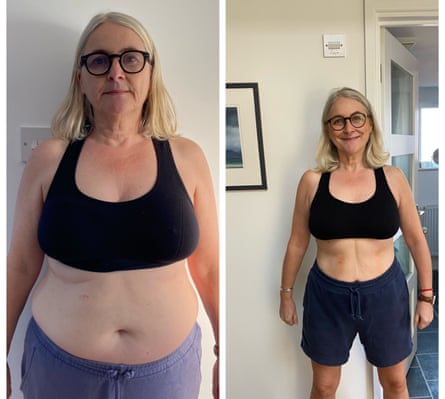
There is no weighing on the Six Pack Revolution. Instead, you take weekly pictures of yourself – you have to show your belly. At the start, it’s the worst thing you can imagine. I stared at my day one picture and cried. My six-month illness had left me bloated and unhealthy. I looked utterly miserable. There is no way, I thought, I’m going to let anyone see that picture. And then, week by week, you watch yourself getting smaller: I was shrinking before my eyes, a waistline started to appear, my shorts were hanging differently, a smile appeared, I looked bright and happy and healthy again. I now show my day one and day 75 pictures to anyone and everyone. I showed them to a cab driver a few weeks ago. He then tweeted me to tell me that he had signed up.
The food programme is perfectly manageable: it asks you to eat six meals a day. A typical day might involve eggs and asparagus for breakfast, cottage cheese on rice cakes mid-morning, pan-fried sea bass with garlic and chilli for lunch, chicken shish with baba ganoush for mid-afternoon, sweet potato jacket with chicken for supper and banoffee ice-cream for evening snack. There are loads of recipes to choose from. You can devise your own menu. If you stick to it like glue, you’ll see phenomenal results. You’ll be provided with meal-plan charts. Fill one in at the start of each week and stick to it. Disclaimer: I didn’t stick to it like glue (I couldn’t eat it all – you won’t go hungry) and still saw great results. It boils down to no booze, chicken and fish as your main sources of protein, and no bad white, starchy carbs. There’s also an option to use meal supplements to substitute breakfast and lunch.
I sleep better, I feel incredible and my energy levels are through the roof. I can’t recommend it enough. It’s given me my life back, and the best bit is that, once you’re used to it, it’s so easy to stick to when the programme is done. I do five days of Six Pack and what I like at the weekends.
‘You’d have to be a psychopath not to find violent conflict intimidating. But it’s also fun’
Marcel Theroux on Brazilian jiu-jitsu

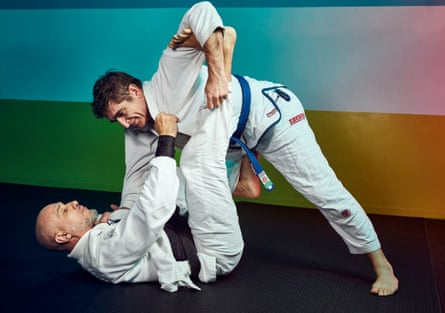
I had wanted to try Brazilian jiu-jitsu for a while before I finally plucked up the courage to have a go. My first exposure to it was through taking my then eight-year-old son to a weekly class. Essentially, BJJ is a system of groundfighting – grappling techniques for controlling and submitting an opponent. It’s related to judo, but modern judo stops quite quickly when the competitors hit the ground. With BJJ, getting to the ground is just the beginning. Once they’re there, competitors use an extraordinary range of grips, joint-locks, arm-locks, leg-locks and chokes to submit the opponent.
I was drawn to it for a number of reasons. I loved how three-dimensional it was. There was something wonderfully free about the way the kids were encouraged to move: rolling, tumbling, wriggling around on the mats. It made me think how rigidly we carry ourselves as grownups. I was also fascinated by its credentials as a fighting system. I’ve always been interested in boxing and Chinese martial arts, and have taken part in both. There are things you can understand only by trying them.
There is no striking in BJJ, and it is drilled into practitioners that they have to stop immediately when an opponent taps their hand to signal a submission. This makes it possible to spar in quite a full-blooded way without getting injured. The BJJ term for sparring – rolling – emphasises this playful aspect. When the children in my son’s class sparred, it looked like kittens playing.
I watched him taking part for about a year before I finally took a deep breath and got on the mat myself, in 2018, just before my 50th birthday. I was quite fearful. I was in OK shape for a 49-year-old. I swam in the lido, did the odd boxercise class and kept up my tai chi practice for balance and flexibility, but you don’t see many people my age doing backward rolls, never mind trying to fight their way out of a rear naked choke.
My son’s instructors, Pedro Garcia and Benny SooTho, also ran adult classes for their club, GFTeam. I loved the movement: it reminded me a little of PE at primary school. I didn’t spar that day. I sat and watched, very intimidated, as everyone grappled. It looked extremely intense. Suddenly all that rolling movement is put in the service of getting into a dominant position, locking up your opponent’s limbs or neck until they signal their defeat with a couple of taps – or, if you don’t happen to have a spare hand, saying “tap”.
However controlled the sparring is, and however gentle and attentive your instructor is, there is no getting round the fact that, at its heart, practising BJJ involves violent conflict with another human being. You’d have to be a psychopath not to find that intimidating. But it’s also fascinating. How would you cope with someone sitting on your chest, trying to cut off your breathing? Or hyperextending your arm so that if you don’t tap your opponent’s hand, it will break? How long do you think you’d last? At what point do you give in?
I rolled at the following week’s class and it was like being hit by a soft train in pyjamas. I had no idea how to keep my opponents off me. I flailed around and got submitted almost immediately. For the first few weeks, I would sometimes sit out the sparring. But I would then regret not rolling. It felt like going to a restaurant and having only a starter. It turned out that the only thing worse than getting on the mat and being repeatedly submitted was not doing it.
Stepping into the gym, choosing to spar and competing in tournaments have expanded my idea of what I’m capable of
Four years later, I still find sparring intimidating and I sometimes feel a vague dread before class – particularly if I’ve missed a few and am rusty. But the reason I keep going is simple: after every single class – even, or perhaps especially, the ones where I’ve been smashed by everybody I’ve rolled with – I have a rush of endorphins. I feel extraordinarily calm, happy and stress-free. I’ve gained strength and flexibility, and lost weight. And I enjoy the companionship of the people who are choosing to undergo the same challenges. We are putting our wellbeing in each other’s hands and that gives rise to trust and mutual respect. It takes a lot of courage to walk across the threshold of a martial arts gym and participate.
I have no idea how long my body will keep up with this, but it has been a transformative experience. I’m in better physical shape than I have been for many years, but the more intriguing changes are mental. Those gradual increases in intensity, from stepping through the door of the gym, to choosing to spar, have expanded my idea of what I’m capable of. The process acquaints you with your courage.
This year, one of my teammates persuaded me to sign up for a competition. Not so long ago, that’s something I would never have contemplated. When I calculatedly missed the application deadline, my teammate Heath told me to send an email to the organisers. I couldn’t bring myself to say that I was too scared, so I did it and they slotted me in. I was bracketed with people broadly my age and weight, but it was still terrifying. As it turned out, I won both my fights.
Then I competed again in November, and lost my only match on points. That did sting, because I had improved, and yet I was still beaten. In the aftermath, I found myself reflecting on grips that I hadn’t dealt with, an opening that I hadn’t taken advantage of. It’s given me another challenge: how to improve my decision-making under pressure. Our senior instructor, Pedro, who’s a second-degree black belt, still competes, wins some, loses some, and seems at ease with whatever the outcome. That strikes me as very enlightened.
One of the other great joys of Brazilian jiu-jitsu is that I get to train with my now 14-year-old son. We are the oldest and the youngest members of the class, respectively. Of course, it’s a challenge to keep turning up there, to surrender to the process and not fixate on an outcome, to eat victories and defeats with equal relish, to get comfortable with discomfort and continually accept loss as a teacher, not a verdict. But it’s also – and this might sound odd – enormously fun.
GFTeam are at en.gfteamofficial.com. For information on other clubs, go to ukbjja.org/find-a-club/
‘I’ve fallen in love with making myself stronger’
Monique Roffey on strength training
In May 2021, I joined a gym. While many put on weight during lockdown, I’d lost 9kg (20lb) from walking every evening, no social eating and doing online Hiit classes twice a week. But I was itching to get even fitter. Fitness has its momentum; the fitter you get, the more of it you want. I had seen many “strength training” clips on Insta of women of all ages pumping iron and I knew instinctively that there was something here.
While I had never lifted weights before, I knew it improved bone density, muscle and overall wellbeing. In 2018, a fractured foot led to a bone scan that had uncovered osteopenia (less severe than osteoporosis), common in women my age – and I hoped it would help.
I joined a local mixed gym and hired a male personal trainer. Joining a proper weights room is intimidating. It looks like a torture chamber. Actually, it is one. Racks, benches, unfathomable contraptions, dumbbells, kettle bells, barbells – all industrial looking – ropes and pulleys, and buckets of clips, resistance bands and even sandbags. I felt small (these gyms are full of large, muscle-bound men) and men did flirt, incredibly, even with my 57-year-old professor’s arse. I was stunned. Me? Not cool; not there, where I felt vulnerable and was trying to get fit in private. And so, in November 2021, I found StrongHer, an all-female training gym close to where I live.
Strength training releases serotonin, the feelgood hormone. Train consistently and you will feel well consistently
Housed under an old railway arch, StrongHer was founded by women (Tig Hodson and Sam Prynn), for women, and its aim is simple: empowering women. The arch is strip lit and catchy music is on at full volume. It’s like walking into a nightclub, even at 9am on a Sunday.
I tried a couple of high-energy weightlifting circuit classes, but soon realised that all I really wanted to do was work one-to-one. I approached Abi Skipper after attending one of her classes. She is 20 years younger than me, and I loved her huge laugh and positive energy. Finding StrongHer, and meeting Abi, who would become my personal trainer, is up there with those great change moments.
Once I hired Abi (personal trainers at StrongHer range from £50-£80 an hour), I went off-peak, during afternoons, when it’s quiet. It was during my one-to-one sessions that I got to clock the other women coming in: women in hijabs, younger women and other women my age, all quietly racking and deracking their barbells.
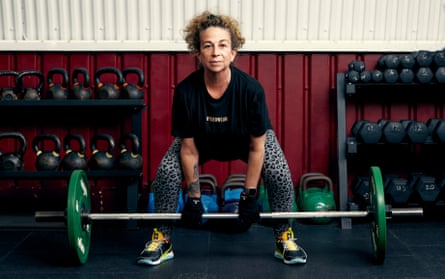
I’ve fallen in love with the process of making my body stronger and more flexible. You don’t need to “lift heavy” to do this. The most I’ve deadlifted (lifting a weight straight off the ground) is 45kg; the most I’ve squatted is about 30kg. I bench 20kg, at a push. In this time, I’ve discovered an old injury in my left quad and had it healed by one of the best physios in town.
I have learned that getting stronger is fun and fulfilling. And that strength training releases serotonin, the feelgood hormone. Train consistently and you will feel well consistently. From the outside, training might look rather meaningless, even a little shallow. But, trust me, lifting weights boosts the soul. It’s an emotional workout, too. And it’s also not about the dreaded mundane female goal of “losing weight”.
Since joining StrongHer, I’ve lost no weight and yet I do look slimmer, or maybe just different. When you train for strength, guess what? You get stronger. My body before strength training was flabby and had lost its lines and shape. Eighteen months in, my arms are firm, my legs are limber, stronger and more shapely, and my arse has never looked better. And yet I’m not that light in weight. I’m a size 14. I’ve gained muscle mass and bone density. In October this year, I also found, through Abi, a great nutritionist, Ellie Geldard.
I tried many apps during my fitness journey, from a Fitbit Versa Lite, for tracking steps, to glucose monitor Veri. All have helped me “track” habits without the dull grind of tracking calories.
www.theguardian.com


