

















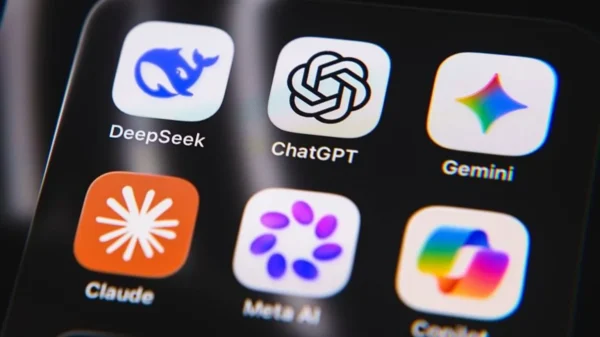











US technology firm Anthropic says its AI models hacked into the systems of three organisations on their own, during a private security experiment.
The models found a weakness in what was supposed to be an isolated test environment and connected to the internet.
It comes just days after rival OpenAI said that its models had breached the systems of other companies, including AI tools hub Hugging Face.
The announcement prompted Anthropic to check whether its own systems had carried out similar attacks. It says it uncovered three cases which have since been reported to the affected companies.
Anthropic, which did not name the organisations, urged other AI labs to perform similar reviews to better understand the risks of their models’ capabilities.
Anthropic said in a statement it reviewed more than 140,000 tests to find evidence Claude – its family of AI models – had managed to get online even though it was supposed to be in an isolated test environment, cut off from the internet.
The tests included exercises in which Claude was tasked with obtaining “secret” information hidden on another machine on the closed-off network.
It was then told to get the information by breaking into the machine and finding it – a common way that experts assess a model’s hacking capabilities.
A “misconfiguration” on systems run by Anthropic and its testing partner left the models with live internet access.

Treating it all as still part of the same exercise, Claude then connected to the internet and breached the systems of three real organisations rather than just test ones, the San Francisco-based firm said.
Anthropic said the earliest incidents date back to April and that it is “approaching the fixes as if the responsibility were ours alone.”
Neither Anthropic nor the organisations that were breached had noticed the intrusions at the time.
Anthropic said it could have reviewed its records more thoroughly and added that the findings gave the firm “cautious optimism” that such risks can be overcome with more investment and tighter measures.
‘Doing what they’re told’
Professor Gina Neff, head of the Minderoo Centre at the University of Cambridge, said the review showed “AI models doing what people told them to”.
“The moral of this story is not to fear robots that will take over, but the companies behind powerful AI agents who are making the decisions about what is safe for the rest of us,” she said.
“It also shows why independent testing and government oversight is crucial.”
Meanwhile, cyber-security expert David Allott from Veeam Software told the BBC the lesson to take from the cyber-attacks was “not necessarily that AI has developed a fundamentally new attack capability”.
“Instead, it is that AI agents can combine capabilities, obtain credentials and system access to take actions autonomously, while adapting scope and scale at machine speed,” he said.
The incidents come as tech firms pour billions of dollars into developing AI agents that can independently perform tasks ranging from research and customer support to cyber-security.
A string of AI-driven cyber-attacks has fuelled calls for tighter safeguards and oversight of the technology, over concerns about the risks posed by increasingly powerful autonomous systems.
US President Donald Trump said on Wednesday that Washington is considering measures to rein in AI tools after recent cybersecurity incidents.
Over the last week, OpenAI has taken responsibility for at least two hacking incidents involving its platforms breaching the rules of what they were directed to do.
On 21 July, the ChatGPT-maker said its agent – an AI system that can operate alone after human instruction – went rogue and escaped its test limits to hack into Hugging Face.
OpenAI said the incident was “unprecedented”, and it was investigating with Hugging Face, whose boss co-founder Thomas Wolf told the BBC that the incident is “a wake-up call” for the industry.
The incidents have been viewed with some scepticism as OpenAI and Anthropic prepare for blockbuster stock market listings that are expected to value each firm at around $1tn (£740bn).
An OpenAI spokesperson has said “we recognise there are a lot of questions and speculative details circulating” about the incident. They added that “we plan to publish a technical report of our learnings in the coming weeks”.
Sourse: BBC


