


































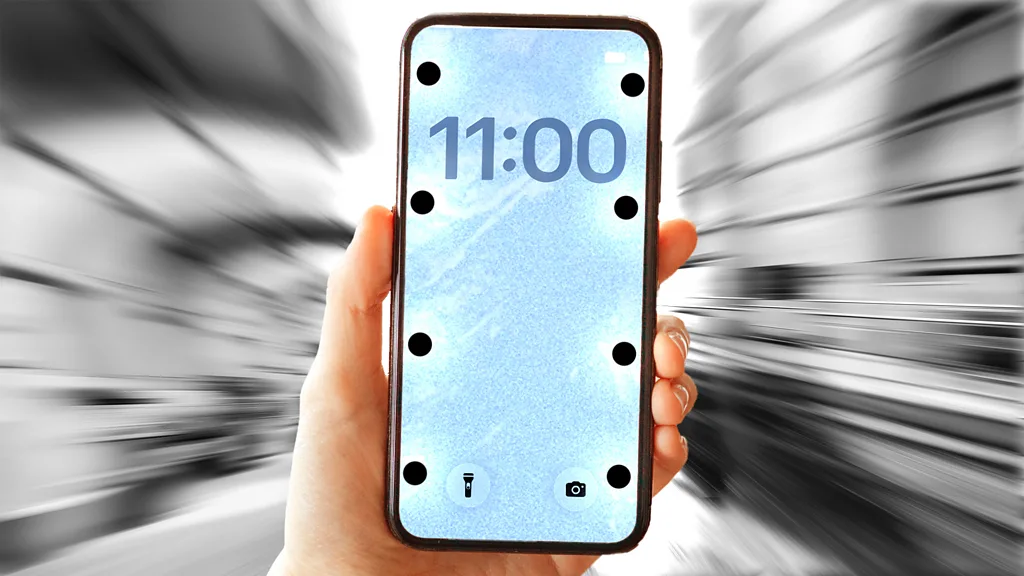
A hidden iPhone setting is turning heads and saving stomachs. But does relief just mean more time staring at your screen?
I try not to look at other people’s phones, but you get unintentional glances jammed in the crowds on the New York subway, bodies lurching around as the train blasts through tunnels. Lately I’ve noticed something strange. I keep seeing people with dots dancing across their screens.
The more I saw it, the more I needed to know. It turns out all these people have something in common: they get motion sickness.
This choreographed dot ballet is a lesser-known iPhone setting called “Vehicle Motion Cues” that’s supposed to help. It puts animated dots on the edges of your screen, which move in sync with the motion of the vehicle you’re in, thanks to the phone’s accelerometer.
Reviews are mixed, but over the past few months, some people have gone wild for it. One man I met on the subway told me he loves the feature so much he keeps it on 24 hours a day, even when he’s not moving – though he declined to share his name with the strange journalist asking questions on his commute.
The dots could be an antidote if you’re cursed with a history of queasy car rides. I was born with an iron stomach, so I’m afraid I can’t relate. But I think there’s something more interesting happening. Bit by bit, our devices are adapting to infiltrate more of our lives.
A phone for what ails you
Here’s some trivia I learned talking to doctors for this story: it seems like most of the people who study motion sickness get motion sickness.
“When I go on a cruise, I’m in my bunk for like 72 to 96 hours. I can’t eat, I can’t get up,” says Tom Stoffregen, professor emeritus at the University of Minnesota, US, who’s been studying motion sickness since the 1980s.
Experts disagree about what causes motion sickness. The classic explanation is “sensory conflict theory”: your inner ear detects movement, but other senses (like your sight) see a bunch of fixed objects that seem like they aren’t going anywhere.

Stoffregen doesn’t buy it. Instead, he says the issue is your muscles and other bodily systems are constantly guessing where you’re about to move to control your posture, and you get discombobulated when the prediction fails. That might explain why passengers get sick but drivers usually don’t, because they’re controlling the car.
Either way, the confusion makes some of us nauseous, says Kristen Steenerson, a clinical associate professor at Stanford University, US, who studies the vestibular system, which controls balance.
“That deviation is what makes people feel dizzy, or disoriented,” says Steenerson. “And probably due to some interesting evolutionary coincidences, that elicits a lot of nausea.” We may have evolved to assume we’ve eaten something toxic when we feel disoriented, she says, so your body thinks it a good time to vomit.
If you can give your body signals that demonstrate how you’re moving through space, it can mitigate motion sickness, Steenerson says. The iPhone’s dots seem to follow the same logic. “They give you a sense of how you are moving in space,” she says.
“There is some research that has looked into visual feedback and found it can be very helpful,” says Steenerson. For example, you can buy phenomenally goofy anti-nausea glasses that are filled with liquid that sloshes around in a similar fashion, and there’s evidence they work. If you’ve never seen them, I am delighted to present you with the photo below.
Steenerson says the dots help a little with her own motion sickness. “Everyone thinks there’s something wrong with my screen. These dots are so cool,” she says.
To turn it on, open your iPhone Settings > Accessibility > Motion > Vehicle Motion Cues. You can leave the dots on perpetually or have them turn on automatically when your phone detects motion. Android apps can replicate the setting, and there are rumours a similar feature is coming to Pixel phones.
You can also change the size and colour. I’ve been walking around with big purple dots on my screen that make for great conversation starters.
Some motion sickness victims told me vehicle motion cues didn’t help, but some people call them a miracle.
Zandie Brockett, a curator from New York City, swears by them. “It’s been a game changer,” she says, enough to turn her into an iPhone-dots evangelist. “I’m not screaming about them from the rooftops. But I recommend them anytime someone tells me they get car sick,” she says.
I heard the same from my old boss, Rory Carroll. His car sickness is particularly ironic, as he spends a lot of time in the passenger’s seat for work: he’s editor-in-chief of Alloy, a car enthusiast news publication. “It’s a bit of an occupational hazard,” Caroll says. “It’s solving a very specific problem that I’ve had my whole life. The dots really work.”
Fans of the iPhone dots kept telling me the same observation. They are only useful when you get motion sick because you’re looking at your phone.
In other words, your reward is yet another opportunity to look at your screen. Which isn’t a reward at all, perhaps, when so many people worry about screen time. “It is a bit of a bummer to have one less reason not to look at Instagram,” says Carroll.
Phones consume modern life, and new developments are letting them creep into the few remaining times we can’t use them. Ever-growing battery life means screens stay on for longer. Elon Musk and his competitors have blanketed the sky with satellites that beam Wi-Fi and phone service to once disconnected areas.
There’s even a rumour that Apple is working AirPods with cameras in them, not for taking photos, but to serve as eyes for new AI voice tools you can use screen-free. It may allow for new computing opportunities in those rare phoneless moments, like when you’re walking down the street.
If looking at screens makes you car sick, you might want to try the iPhone dots. Or – stop me if this sounds crazy – you could just put your phone down and enjoy the ride.
Source: BBC


