

























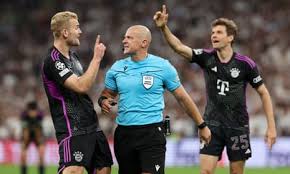
This is a snapshot of X and Instagram after Bayern Munich crashed out of the Champions League last week. Marciniak’s crime? Blowing for offside too early, which meant that a possible Matthijs de Ligt equaliser could not be reviewed by the VAR. Even a freeze-frame image could not confirm whether De Ligt was onside or not. But that didn’t stop Bayern’s manager, Thomas Tuchel, saying the referee’s decision “felt like a betrayal” – or the bile on social media.
Really though, this could have been any sport, in any language, on any given day. This is the way we live now. That much was clear listening to Wayne Barnes, who refereed the 2023 Rugby World Cup final, talk almost prosaically a few days ago about the chilling threats he had received to his life, wife and kids for merely doing his job. “As referees we don’t mind getting criticised,” he told Sport Resolutions’ annual conference. “But on the back of the Rugby World Cup there were threats of sexual violence to my wife, threats of violence against my children. And you’re like, is that really what sport is about?”
It’s not much better at grassroots level. As a senior tennis official, Andrew Nicholas-Wynne told the conference abuse from parents at junior events is now so bad that Tennis Australia has started giving umpires body cameras. Meanwhile Mike Riley, the former Premier League referee, pointed to the consequences. “Three years ago, we had 280,000 referees across Europe,” he said. “Now we have 240,000 and we are haemorrhaging referees at the rate of 20% a year.”
So how do we fix this? That is what Barnes, Nicholas-Wynne and Riley wanted to thrash out in their session at the conference, entitled Sport’s Overlooked Blind Spot: Addressing Abuse Against Match Officials. And tentatively there was a sliver of light amid the darkness, of more sports wanting to lance a festering boil, and having sharper tools to do it.
The first point that struck home was that, when social-media experts track online comments in real time, they find that post-match attacks by players, coaches and pundits – especially when they use loaded words such as “betrayal” – can lead to more abuse than the referee’s original decision. “We all know that as soon as someone in a position of responsibility makes a comment you get a pile on,” Barnes told his audience. “And when you’ve then got people saying ‘we know where your kids go to school’, it plays with your mind.”
It’s hard to stop pundits being pundits, but when it comes to players and coaches, Barnes suggested that stronger punishments would help “concentrate the mind”. He cited the £10,000 fine dished out to Jack Nowell last year, when he was playing for Exeter, after he tweeted that a sending off of a teammate was “one of the worst decisions I have ever seen” as an example.
A second related point: players at grassroots level copy what goes on at elite level. Therefore the tone from the top is vital. Riley hailed English football for “leading the way” in introducing heavier fines for when players crowd officials – including Manchester City receiving a £120,000 punishment during their 3-3 draw with Tottenham last December. And when clubs such as Arsenal and Leicester Tigers go after their own fans for abusing officials – whether it is in the ground or online – it makes it clear that such behaviour is not acceptable.
Third, artificial intelligence technology now exists to detect, identify and provide police with evidence of abuse, along with the antagonists behind it, even when they hide behind pseudonyms. Barnes noted World Rugby’s groundbreaking initiative with the data company Signify AI, which led to an Australian being successfully prosecuted last month after a referee and his wife received threatening and abusive messages via Facebook during the World Cup. Of course such technology isn’t cheap, and the number of prosecutions is still very low. But when organisations such as World Rugby and the International Olympic Committee (IOC) invest in it, it sends a message to those making threats and those in the firing line. As Signify’s Jake Marsh’s put it to me: “Those on the receiving end in sport want more done about abuse. You can’t walk down the street and issue a death threat. But people just think they can say what they want online with impunity. So even if it is just one prosecution for now, it has an impact because athletes and officials know something can be done.”
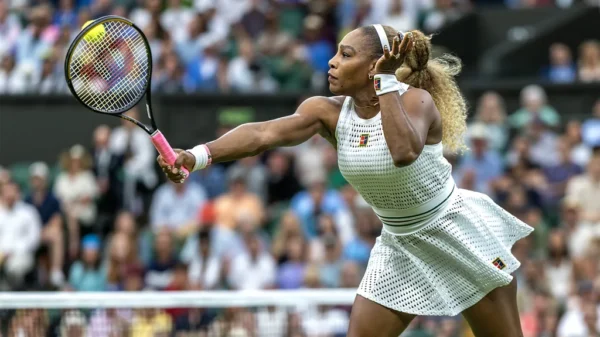
There was another point that struck home when chatting to Nicholas-Wynne. For all the criticism of technology in sport, one unappreciated benefit is that it has lowered the number of game-altering mistakes by referees and umpires – which, in theory, should lead to less abuse. Sure, it is not always that simple. But before Hawk-Eye, how many times were line judges snarled at by top tennis stars? Technology has clearly helped cricket and rugby too. And while VAR has its issues, it does usually protect officials from their most egregious mistakes.

Andy Murray watches a Hawk-Eye decision on the big screen during his match against Ivo Karlovic at Wimbledon in 2015.
Hawk-Eye has reduced the number of disputed line calls in tennis. Photograph: Jonathan Brady/PA Archive/PA Images
The panel ended with a plea for sport to find better ways to humanise referees. Riley, for instance, noted that, when officials went into Premier League clubs in pre-season and got to know the players, they were less likely to be insulted by them during matches.
Meanwhile, Barnes suggested that if fans got to know officials better, perhaps by them explaining their decisions afterwards, the levels of online abuse might drop. “People just seem to think that we rock up to just ruin their afternoons,” he said. “But if they see that we love the game, they might find it slightly harder to abuse us. One of the reasons why there’s so much social media abuse is because you don’t know your victim.”
That might be wishful thinking. But Barnes’s broader point – that referees try their best and don’t deserve the staggering levels of bile that comes their way – emphatically hit home. And, as he also pointed out, if we continue to chase the best officials away, how will it make things any better?


