



























A handful of returning locals and adventurous tourists are breathing new life into Nyksund, a remote coastal outpost in Norway’s wild northwest
We land on a white sand beach under jagged black mountains. A sea eagle, surprised to see humans, flaps away over the only house with a roof on it – the rest are in ruins. “Hundreds of people used to live here,” says Vidar. “In the days when you had to sail or row, it was important to be near the fishing grounds. Now there’s just one summer cabin.”
Jumping out of the boat, we walk along the beach. My daughter, Maddy, points out some animal tracks. “The fresh marks are wild reindeer,” says Vidar. “The older ones could be moose – they come along here too.”
Beyond the end of the beach are the small fields that the inhabitants once cultivated, now covered in wild flowers. In winter this would be an inhospitable place, but at the height of summer the flora and fauna are booming under a sun that never goes down. The people hunted a special type of cod, Vidar explains, the skrei, which migrates west from the Barents Sea to breed off Arctic islands such as this one, Skogsøya. This is the extreme edge of north-west Europe, isolated from the rest of Norway by a maze of twisting fjords and snow-capped inner islands. Head west from this beach and the first landfall is Greenland.
“When did everyone leave?” I ask, watching an otter swimming around the cove and diving into the kelp beds.
“It started with the terrible Arctic storm of 1893 that killed many people. Then the marine diesel engine came and they didn’t need to live out here. By 1952, they were all gone.”
Rudolf Diesel probably never meant to redefine the meaning of “remote”, but that’s what his eponymous engine did. Patented in that same year of 1893, his invention would inadvertently redraw the map of this coast. Places once inaccessible up long fjords could now prosper as sheltered havens, but exposed outer-island fishing villages, inhabited only for their accessibility to sailing and rowing boats, were left to return to wilderness.
Jumping back on the boat, we head northwards, weaving between rocky islets and rafts of puffins. Three sea eagles watch us warily. Then Maddy spots a group of black fins slicing towards us through the waves. Vidar cuts the engine. “You’re in luck,” he grins. Seconds later four orcas come rolling past, blowholes blasting – three adults and one calf, heading for a local seal colony. “Mostly they eat herring,” says Vidar. “But some do know how to catch seals.”

Back on the boat, we head north, weaving between rocky islets and rafts of puffins. Three sea eagles watch us warily
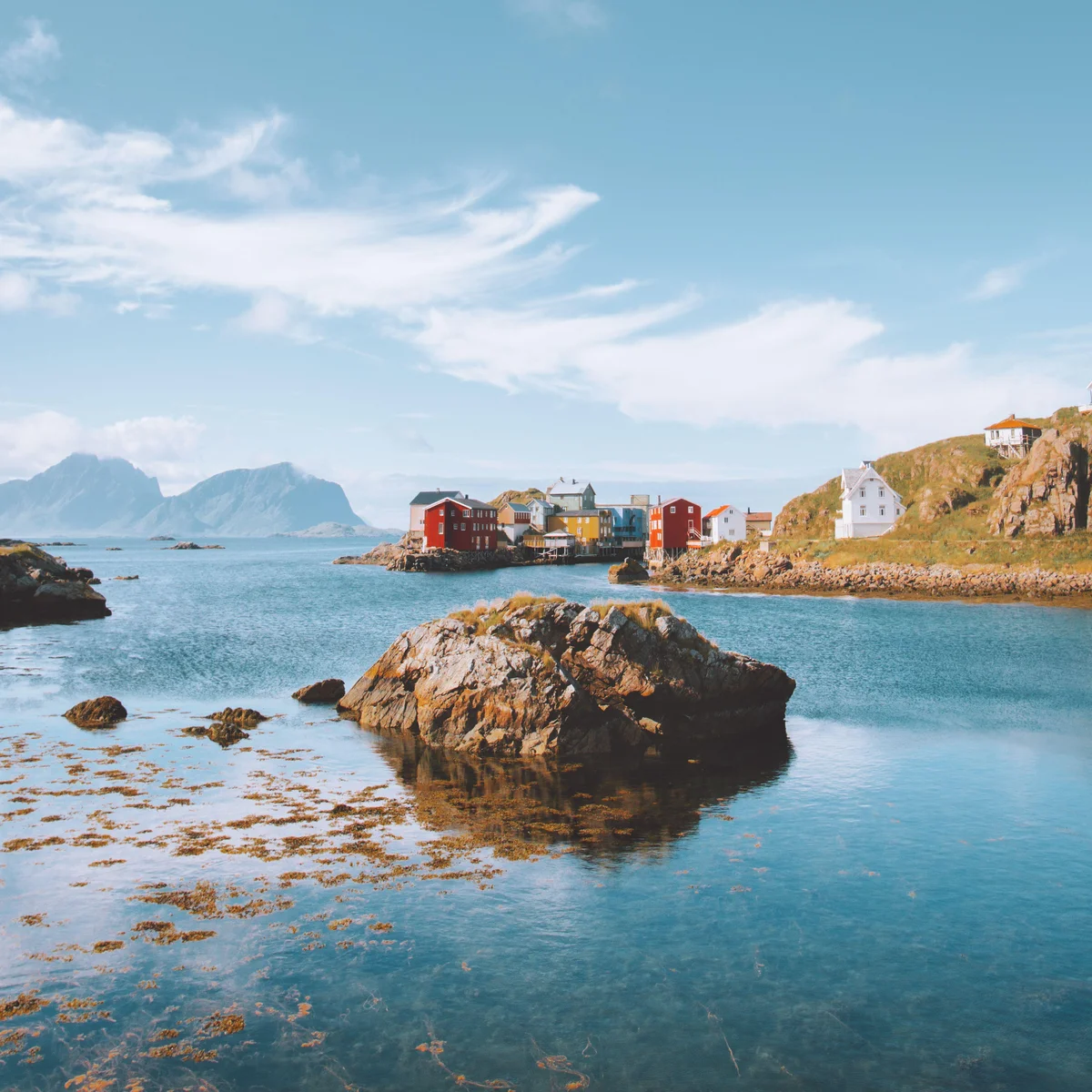
After a few precious minutes watching the orcas, we head back to Vidar’s base, the village of Nyksund, carving a tight bend through a narrow gap formed by a pair of craggy islands, then into the little harbour. The two sides of this tranquil haven are lined with clapboard houses, fish warehouses and rusting cranes. There are clamouring kittiwakes nesting on every available ledge; the wharves and decking have gaps; much of the paint is peeling. But this is a pretty spot, not gentrified – not yet. Nyksund is another abandoned fishing village, but with a difference. The people are coming back.
On the quayside, I meet Dan and Johanna, who will be our guides. They came here in the 1990s, finding only one aged resident remaining. The rest had left in the 1970s, tired of the awkward tiny harbour and crunching winter storms, but now the population is back up to more than 20.
That afternoon, we set out with Johanna on the Dronningruta (the Queen’s Route), a spectacular nine-mile (15km) hike that is Nyksund’s biggest attraction. The route leads up on to a ridge where I begin to see why this path is a favourite of Norway’s Queen Sonja. First, there are views south to the soaring mountains of Skogsøya, then a vast panorama of snow-capped peaks and islands opens up to the north. The lower slopes are emerald green all the way down to the azure sea. Under our feet is a thick carpet of leaves and flowers. On the windswept summits, juniper bushes grow horizontally, sheltering behind 5cm-tall crowberry bushes.
Finally we descend into the fishing port of Stø, taking a detour to see the church at Langenes, a rustic wooden masterpiece, parts of which date back to the 16th century. On the wall, in Gothic script, is the Lord’s Prayer in Old Danish, a reminder that Norway was under the control of Copenhagen for many centuries, achieving full independence only in 1905, after being ceded to Sweden in 1814.
We skip the return leg along the coast, opting for the boat service that shuttles us back to Nyksund. There is no second sighting of orca, but the ride is still an exciting rollercoaster through the swell, with an audience of seals and black guillemots. Back in Nyksund, we drink a beer in the cosy Holmvik Brygge bar, then eat a plate of local seafood in the Ekspedisjonen restaurant. Specialities include tørrfisk (skrei cod, air-dried then soaked in running freshwater for a week before cooking), black halibut and torsketunger, tempura-style cod’s tongue.
Sourse: The Guardian


