































Two men and a woman have been killed as the remnants of Hurricane Ophelia hit the British Isles.
As hurricane-force gusts battered the Republic of Ireland, one woman and a man died in separate incidents when trees fell on their cars.
A second man died in a chainsaw accident while attempting to remove a tree felled by the storm.
Across Ireland, thousands of homes and businesses are without power and all schools have been shut.
About 360,000 homes and businesses in the Irish Republic, and 16,000 in Northern Ireland, are without power.
About 4,000 customers in Wales have also lost power.
‘Stay indoors’
The woman, in her 50s, died near Aglish, County Waterford, and a female passenger, in her 70s, was injured.
Her injuries were not believed to be life-threatening, the Gardai, Ireland’s police force, said.
One of the men died near Dundalk, Co Louth, after his car was struck by a tree at about 14.45 BST, the Gardai said.

The other man, in his 30s, was killed in Cahir, Co Tipperary.
All road users were urged to stay indoors and not travel unless their journey was absolutely necessary.
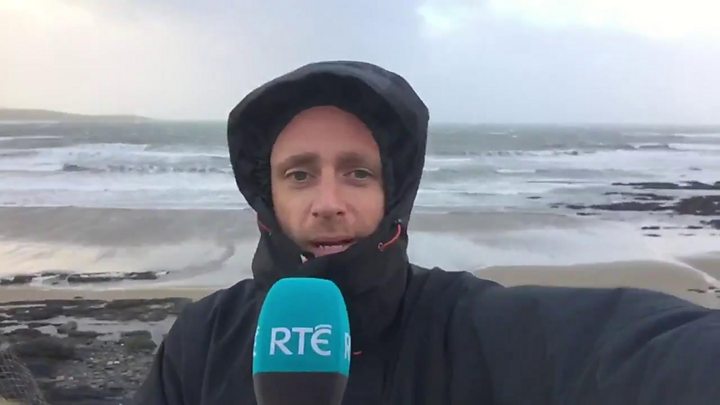
The Met Office has warned of “potential danger to life”, with wind gusts off the south coast of Ireland reaching 109mph (176km/h) at Fastnet Rock.
An amber warning – indicating a potential risk to life and property – for Northern Ireland, Wales, south-west Scotland and the Isle of Man is in force until 23:00 BST.
A yellow warning of “very windy weather” also covers parts of Scotland, the west and north of England and Wales.
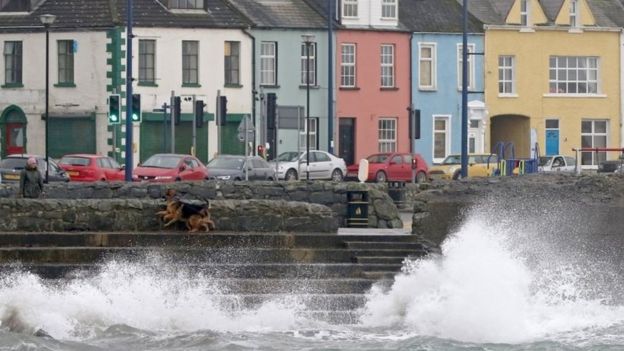 An amber warning is in force in Northern Ireland
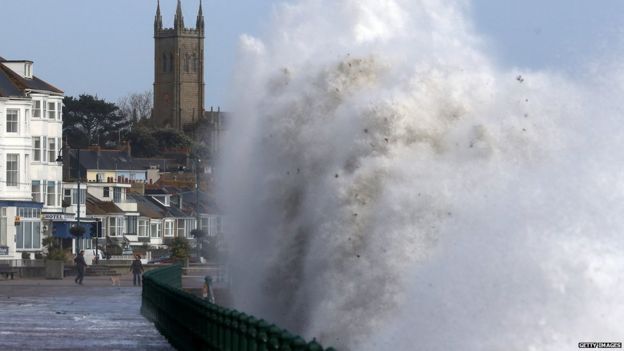 Waves crashed onto Penzance seafront in Cornwall
It could be several days before power is restored to some homes in the Republic of Ireland, ESB Networks has warned.
The roof of Cork’s football stadium has also been blown off by the winds.
In Wales, the Cleddau Bridge was shut to high-sided vehicles, Pembrokeshire County Council said. All schools in the county have been closed.
Elsewhere in the UK, skies have turned red and yellow as Ophelia drags dust from the Sahara through the atmosphere.
- Are you affected by Hurricane Ophelia? E-mail your stories and pictures to haveyoursay@bbc.co.uk or WhatsApp: +447555 173285
Ophelia has arrived from the Azores in the Atlantic Ocean and coincides with the 30th anniversary of the UK’s Great Storm of 1987.
The BBC’s Ireland correspondent, Chris Page, said it would be the most severe storm to hit Ireland in half a century.
- Ophelia hits: Latest updates
- Amber warning for Scotland
- Storm closes schools and cuts power in Wales
- ‘Smoke smell’ forces flights to land
The Irish Republic’s Met Eireann said the storm was forecast to continue travelling north over western parts of Ireland, with “violent and destructive gusts” of 75mph to 93mph (120 km/h to 150km/h) expected countrywide.
It also warned of possible flooding due to heavy rain and storm surges.
“There is a danger to life and property,” it said.
It has issued a red alert for the country.
In England, three flood warnings – meaning flooding is expected – have been issued in the South West, and there are several flood alerts – meaning flooding is possible – across other parts of the country.
The Scottish Environment Protection Agency has put a series of flood alerts and warnings in place for south-west Scotland.
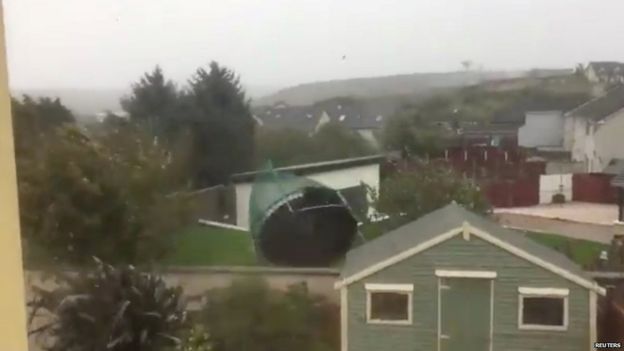 Image copyrightREUTERS
In other developments:
- Dublin Airport said about 130 flights were cancelled. Ryanair, Aer Lingus, British Airways, Qatar Airways, Air France, CityJet, Emirates and KLM have all cancelled some flights due to the severe weather
- Belfast Airport said passengers should check with their airline
- Planes have been grounded at Manchester Airport, with 20 flights cancelled
- Edinburgh Airport said its flights to Ireland had been cancelled but all others were unaffected
- All flights, including that of the mail plane, have been cancelled by the Isle of Man’s airport
- All schools and further education colleges in Northern Ireland and the Republic of Ireland are closed. Schools in the Republic and Northern Ireland will remain closed on Tuesday
- All schools in Anglesey and Pembrokeshire have closed early along with some in Gwynedd. Bangor University and Aberystwyth University have closed for Monday afternoon.
BBC Weather said Monday would be a “day of huge contrasts” with the strong gusts of wind travelling over the Irish Sea and heading north to central and southern Scotland, sparing eastern parts of the UK.
Eastern England is instead expected to enjoy unseasonably warm weather, with temperatures of 22C or 23C on Monday – compared with an average for mid-October of 15C.
Highs of 24C were recorded in the region on Saturday as some parts of the country basked in a “mini heatwave” thanks to warm air brought by Ophelia.
Read more at bbc.co.uk


