




























Invisible Cities’ tours take visitors to the Scottish capital’s juiciest and least-known stories – and with guides who have known homelessness, they are rooted in real experience
Edinburgh is a city that wears “dreich” weather well. The gloomy, overcast greys and short, damp days of winter suit the brooding architecture, and the Scottish capital’s often murky, deviant past.
These are the streets that were bombarded during the wars of Scottish independence, giving Edinburgh’s centrepiece the claim of being Europe’s most-besieged castle. It’s where cages once had to be introduced over graves to stop bodies being dug up and sold to the medical school, and where, round the corner, tightly packed tenements hosted peasants and poets, philosophers and kings. The city is, as the poet Hugh MacDiarmid wrote, “a mad God’s dream”.
I’ve lived in Edinburgh for over two decades now, but the centuries of stories hidden in the city’s stones continue to surprise me. They reveal themselves only to those who know where to look.
Angus Stirling is one of those who know: he’s an expert on the architecture and the layers of stones that make up Edinburgh’s old town. He knows who put what where in the medieval era, and which Victorian personage paved over it in the 1800s in an attempt to modernise. Angus is a tour guide with Invisible Cities, a social enterprise that trains people who have experienced homelessness to lead walking tours. Started by Zakia Moulaoui Guery in Edinburgh in 2016, the company now runs four tours in Edinburgh, and also operates in Glasgow, Manchester and York. Norwich, Liverpool and Cardiff will be added later this year.
Continually altered, adapted and restored, the Royal Mile is a living witness to Scottish history since the middle ages
I’ve signed up for the Royal Mile: Huts to High-Rises tour (£12), which takes in the city’s most famous street and the old town around it on a 90-minute stroll. “Continually altered, adapted and restored, the Royal Mile is a living witness to Scottish history since the middle ages,” Angus says. “Stones and cement. You don’t get much more historic than that.” But it’s not the fascination with building materials that sets Angus’s tour apart; it’s that Invisible Cities tours also touch on the social landscape – teaching tourists about local social enterprises as they go.
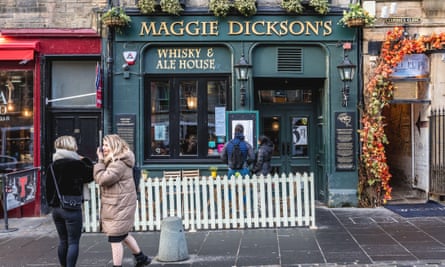
Our visit starts in the heart of the old town, in the Grassmarket, a market since the 14th century and today best known for its wide choice of pubs. “Edinburgh is an old town, and it has a dark history,” Angus says. He tells us how “Half-hangit Maggie” was hanged here in 1724 for concealing a pregnancy and then abandoning the body of her newborn baby – only to wake up a few hours later and climb out of her coffin. Maggie Dickson’s pub (at no 92) is named after her. In 1736 one Captain John Porteous was lynched here by a mob after allegedly firing into a crowd during a riot.
Climbing up the colourful Victoria Street, we next stop at St Columba’s, an easily missed church just off the Royal Mile. Angus tells us about Sparkle Sisters, a charity based here that runs events offering wellbeing services to vulnerable and homeless women. All profits from Invisible Cities go to community projects like this; other examples are street barber services and free tours for Ukrainian refugees. “We start from the Ukrainian Association, walk across Waverley Bridge and up to the castle, and I tell them about places they can take their kids or get cheap clothes,” Angus says.
Angus became homeless after a downward spiral sparked by university debt and a broken relationship – and was offered the chance to train as a guide while working for the Big Issue.

“I thought it was a good opportunity for me to plug people full of Scottish history and language activism,” he says. He speaks seven languages, and has a degree in language and history acquired after four years studying between Aberdeen, Edinburgh and the Swedish city of Linköping. Indeed, on his tour he laments the impact John Knox and the Reformation had on the Scots language.
“The Reformation brought with it the only English-language Bible which was acceptable at that time,” Angus tells us. “In the 1500s, everybody had to go to church, so that meant they would have to listen to the language of the Bible for hours on end.” Scots began to decline as a result, he says, and today its status is quite low: “This is one of the few countries where you’re often thought to be more ignorant if you speak two languages rather than just one.”
This is a tour free from the tartan-tinted viewpoint of many guides. Another tours Angus runs, Languages of Scotland (£12), looks in more detail at how Gaelic and Scots were suppressed in the country. That tour runs further down the Royal Mile to John Knox House, then the statue of poet Robert Fergusson – a leading light of the Scots vernacular revival – outside Canongate Kirk, and finishes at the Scottish parliament. “I bring in the changes that have happened since it reopened,” he says. “In legislation, theoretically we now have full status for Gaelic and Scots. There’s not any money behind it, but the law is behind it.”
www.theguardian.com


