































In 1893, a teacher scaled Pikes Peak in Colorado and penned one of the US’s most cherished songs, “America the Beautiful”. Today, travellers can retrace her historic ascent.
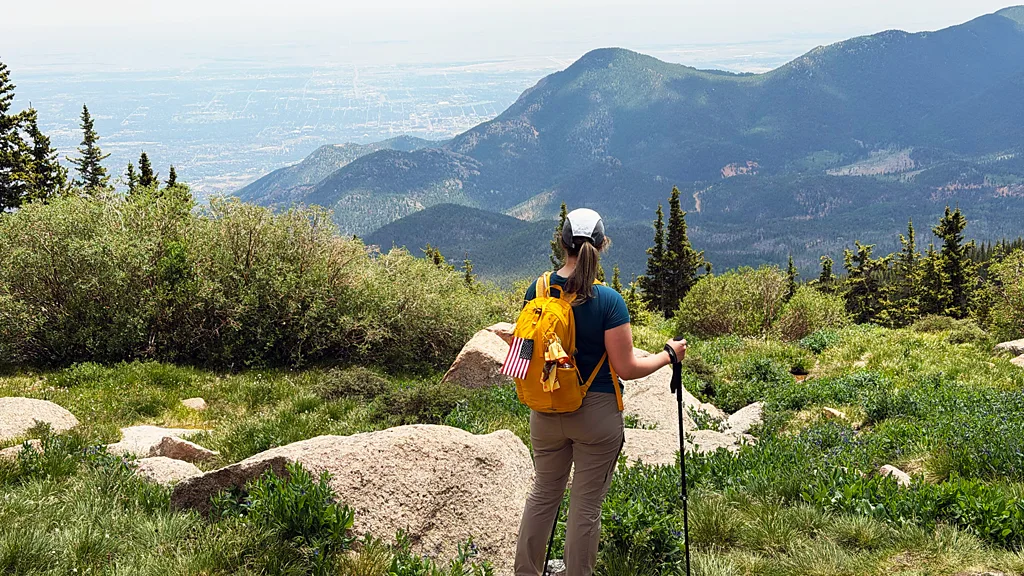
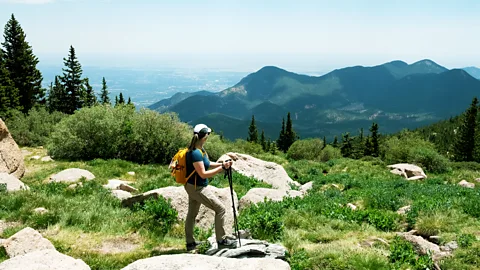
The tip of my trekking pole bites into the rocky path. “Hang on,” I wheeze to my husband, who is plodding several paces ahead. Pausing to gulp water, I survey the landscape below. Pine-stubbled peaks surround us, dappled in cloud shadows and sloping downward to meet a lush valley criss-crossed with roads.
“Ready?” my husband asks. I reluctantly get back to my feet, and our trekking poles resume their clacking rhythm. The mountaintop is still hours away.
We’re hiking up to America’s most-visited mountain summit: Pikes Peak in Manitou Springs, Colorado. One hundred and thirty-three years ago, the view from the top inspired Katharine Lee Bates to pen “America the Beautiful,” a poem that became one of the nation’s most well-known patriotic songs, played at sporting events, recited on the Fourth of July holiday and taught to American school children. But not all of us know about the author or why she wrote it.
Having moved to Colorado just a few years ago, I too was unaware of the backstory. But in honour of America’s 250th anniversary, I’m attempting to follow Bates’ journey up this 14,415ft (4394m) high peak to see if the view of our country’s landscape still inspires the same way.
A teacher goes West
In 1893, 33-year-old Katharine Lee Bates was teaching English literature at Wellesley College in Massachusetts, when an exciting opportunity arose: the chance to lead a summer session at Colorado College.
Colorado had only become a state 17 years earlier, and the college was then barely two decades old. It was a period of social and political unrest – Grover Cleveland was in his second presidency, the US stock market was nosediving and unemployment was at a high. Nonetheless, Bates was eager to see the expansive views of the American frontier. She boarded a steam engine train and headed west.
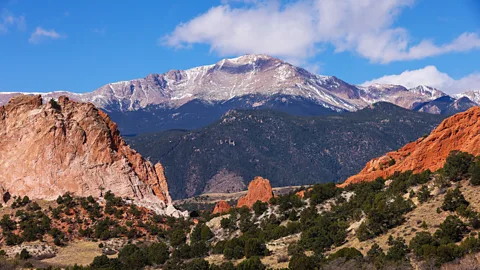
In Melinda M Ponder’s biography of Bates, Katharine Lee Bates: From Sea to Shining Sea, she writes that upon arriving in Colorado Springs, the intrepid teacher was instantly charmed by the progressive energy of the young city. She and her companions made the most of their free time. “We were driven to Manitou, to The Garden of the Gods… to canyons… and cascades innumerable, all so marvelous that our stock of exclamations gave out,” Bates journalled. “An enchanted summer!”
Leah Davis Witherow, curator of history for the Colorado Springs Pioneers Museum, explains that many travellers at the time were captivated by the American West. “This was the era of the picturesque, so this scenery would have been wildly fascinating to her,” she says. “It would have been exciting and strange, and it must have inspired awe.”
It wasn’t long before Pikes Peak tempted the group of adventurers. Forgoing the ease of the recently built Cog Railway in favour of a more nostalgic, pioneering journey – a horse-pulled wagon up the carriage road – Bates and her colleagues started their bumpy ascent.

My journey begins
Today, the Cog Railway still runs along its original 1890s path, but the tracks have been replaced and the steam locomotives swapped out for diesel-electric trains. For an experience that more closely resembles the slow, arduous uphill climb of Bates’ wagon we also chose to skip the train and take the journey on foot.
At 05:30, we pull into one of the last spaces at the parking lot for Barr Trail, which leads to the summit. Gaining 2,255m in elevation over 21 uphill kilometers, this route is one of the region’s most strenuous hiking trails. We apply suncream and begin our pilgrimage. The trail glows pink from the rising Sun, a crimson orb peeping over the hills. Hummingbirds trill and alight on spindly branches to watch our ascent. Half an hour flies by, and my sports watch chimes the one-mile (1.6km) mark. Just 12 more (19km) to go!
After three miles (4.83km) of steep, sweaty climbing, we spot two local hikers ambling down the trail and strike up conversation. One of them, Ben Johnson, shares that he has ridden his bike to the top of the mountain twice. “Getting up high on Pikes Peak and looking out, it’s beautiful,” he says. “America is phenomenal. E pluribus unum: out of many, one. I still believe that.”
His words energise us. Less than two hours later, we arrive at the hike’s halfway point, Barr Camp, a rustic backcountry lodge and campsite.
The camp host heats up some coffee for us. “You’ve got six miles (9.7km) left and that last climb is rough,” he warns. I shrug – it can’t be much worse than our exerting ascent up to this point.
From sea to shining sea
Bates’ wagon also paused halfway up the mountain, where its tired horses were swapped out for sure-footed mules. Her final ascent was a slow upward slog, as the mules strained up the frozen carriage road. At last, they reached the summit.
Exhausted from the jostling ride, Bates and her friends were nonetheless awestruck by the views. Alas, one professor in the group promptly fainted from the altitude, and the visit was cut short. Before their hasty retreat, Bates drank in the sight of vast golden plains and rugged mountaintops rippling into the distance. “Most glorious scenery I ever beheld,” she journaled.
“Combined with her journey across America on the train – seeing the plains of Kansas, the corn fields, the wheat fields – coming to the top of Pikes Peak and looking out on this vastness deeply impressed her,” says Witherow. That picturesque vista at the summit galvanized Bates to write a four-stanza poem titled “America.” In July 1895, it was printed in Boston’s weekly newspaper and in 1910, it was paired with a musical arrangement by Samuel A. Ward, re-titled “America the Beautiful.”
My view at the top
At 14:30, nine hours after our start, we finally reach the summit. Our friend at Barr Camp had not exaggerated: the final third of the hike was a series of cruelly steep and rocky switchbacks. Panting, I manage a triumphant grin as my husband takes a photo. Then I turn to behold the hard-earned view.
On a clear day you can see five states – Kansas, Nebraska, Oklahoma, New Mexico and Wyoming. But heavy clouds are rolling in, and haze shrouds the horizon. Our pride of achievement is tinged with disappointment. Like Bates and her friends, our time on the summit must be cut short. We find the Cog Rail conductor in the visitor centre and request a ride down.
Once aboard, we collapse gratefully into our seats. I’ve been told that the view from Pikes Peak is different each time, so naturally, I didn’t see exactly what Bates saw when she looked out. But here on the train, I observe the variety of ages and ethnicities present on the train, people who have travelled from near and far to see “America’s Mountain,” seeking a reminder of what unites us.
One hundred and thirty-three years after her historic summit – and 250 years after the United States was founded – much has changed and much hasn’t. The nation is still wracked with upheaval, uncertainty and inequities. And yet it remains our beautiful home despite hazy horizons.
As we descend, a cog train going up the mountain chugs past, packed with faces eager to take in the famous view. They wave to us through the windows. I wonder what they’ll see.
Source: BBC


